


The battle of Grünwald revisited in miniature.
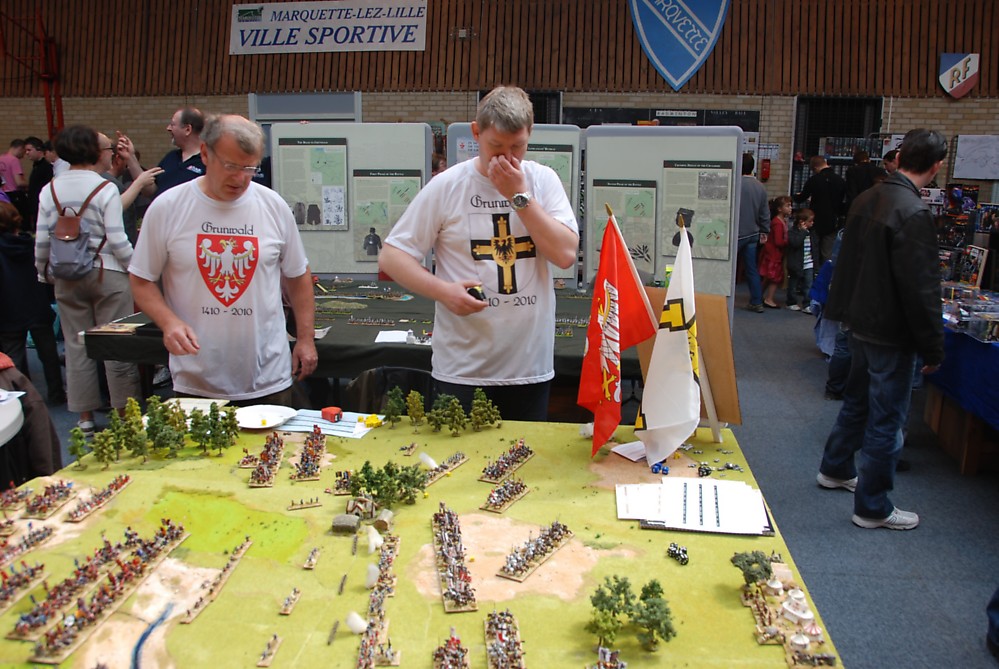
28 may 2011 during an annual Convention Day in Lille (France) two war-gaming clubs from Belgium and France staged the miniature battle of Grünwald. Miniature war-gaming is a fascinating if not well known hobby involving elements of tactical skill and chance, where armies of accurately researched and painted metal figurines march across realistically modelled battlefields to re-fight bygone wars. Such tabletop games can range from re-fights of actual historical battles to speculative “what ifs”, matching armies against foes that never met. These games can be stand-alone in which a points’ system is used to ensure both armies have a fair chance, or can be scenario games with unequal forces and specific victory conditions such as defence of a river line, withstanding an ambush on a marching army or even complex campaigns in which logistics and strategy are as important as tactical skill. Some people might call it a very elaborated form of chess, but unlike chess, a chance factor (by introducing dice) is key to simulate the ‘Fog of War’. The hobby is segmented into “historical war-gaming”, subdivided into different time periods, ranging from the Ancient & Medieval period up to Modern wars and “fantasy war-gaming” simulating either fictional encounters with monsters or Elves or science fiction battles in “space”. This is strictly played on tables so does not cover a totally different hobby of so called ‘re-enacting’ where members are dressed up in historical uniforms and replay history “live”. During the Convention Day a number of war-gaming clubs from France and Belgium showed different aspects of the “miniature” hobby, historical as well as fantasy. Several historical battles were hosted by the clubs, such as Napoleonic battles, a 19th Century Colonial war in Africa and a more recent scenario of the Vietnam War, to name a few. But by coincidence two participants (TADEFIG from Brussels and Francois Harry from FR) each staged the battle of Grünwald, no doubt because of the recent 600 year anniversary, but also because of its size and mobile character (as the swift movement of cavalry of the participating armies played a predominate role). For this demo the TADEFIG club got the support of the Lithuanian Delegation to NATO which kindly offered a part of their exhibition commemorating the battle and displaying on several stands the course of the battle in detail. This background information was very useful for visitors, who were not so familiar with this battle, in order to follow and comprehend the battle demonstrated on the tabletop. In both cases, the historical outcome was repeated, the combined Lithuanian & Polish armies were victorious over the German Teutonic knights, virtually destroying this strong military Order and thus deserving its place amongst decisive battles. Both clubs celebrated together their successful conclusion of the demo’s with an appropriate shot of Žalgiris (courtesy of the Lithuanian Delegation).
28 may 2011 during an annual Convention Day in Lille (France) two war-gaming clubs from Belgium and France staged the miniature battle of Grünwald. Miniature war-gaming is a fascinating if not well known hobby involving elements of tactical skill and chance, where armies of accurately researched and painted metal figurines march across realistically modelled battlefields to re-fight bygone wars.
Such tabletop games can range from re-fights of actual historical battles to speculative “what ifs”, matching armies against foes that never met. These games can be stand-alone in which a points’ system is used to ensure both armies have a fair chance, or can be scenario games with unequal forces and specific victory conditions such as defence of a river line, withstanding an ambush on a marching army or even complex campaigns in which logistics and strategy are as important as tactical skill. Some people might call it a very elaborated form of chess, but unlike chess, a chance factor (by introducing dice) is key to simulate the ‘Fog of War’.
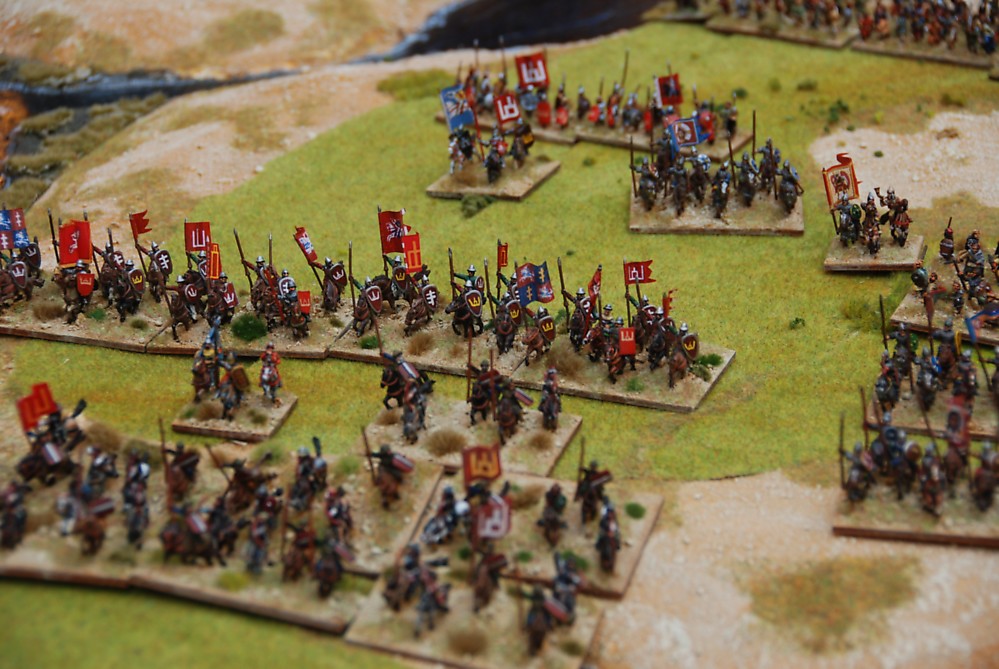
The hobby is segmented into “historical war-gaming”, subdivided into different time periods, ranging from the Ancient & Medieval period up to Modern wars and “fantasy war-gaming” simulating either fictional encounters with monsters or Elves or science fiction battles in “space”. This is strictly played on tables so does not cover a totally different hobby of so called ‘re-enacting’ where members are dressed up in historical uniforms and replay history “live”.
During the Convention Day a number of war-gaming clubs from France and Belgium showed different aspects of the “miniature” hobby, historical as well as fantasy. Several historical battles were hosted by the clubs, such as Napoleonic battles, a 19th Century Colonial war in Africa and a more recent scenario of the Vietnam War, to name a few. But by coincidence two participants (TADEFIG from Brussels and Francois Harry from FR) each staged the battle of Grünwald, no doubt because of the recent 600 year anniversary, but also because of its size and mobile character (as the swift movement of cavalry of the participating armies played a predominate role). For this demo the TADEFIG club got the support of the Lithuanian Delegation to NATO which kindly offered a part of their exhibition commemorating the battle and displaying on several stands the course of the battle in detail. This background information was very useful for visitors, who were not so familiar with this battle, in order to follow and comprehend the battle demonstrated on the tabletop.
In both cases, the historical outcome was repeated, the combined Lithuanian & Polish armies were victorious over the German Teutonic knights, virtually destroying this strong military Order and thus deserving its place amongst decisive battles.
Both clubs celebrated together their successful conclusion of the demo’s with an appropriate shot of Žalgiris (courtesy of the Lithuanian Delegation).
